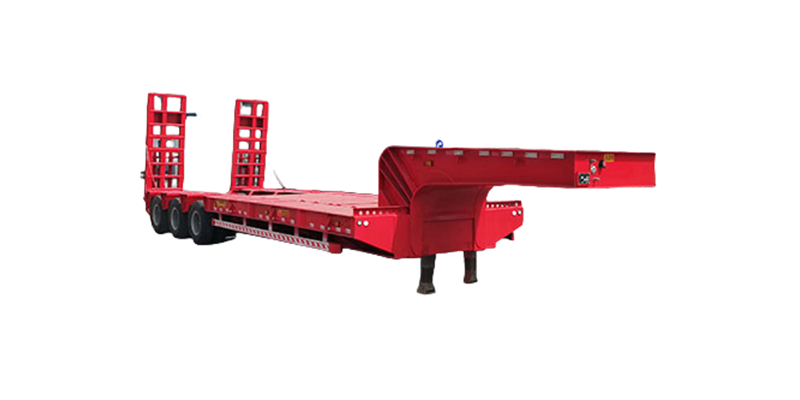
Low flatbed semi-trailer is not a single vehicle model: in order to adapt to different goods, roads, and loading methods, it has evolved multiple structures in three parts: goose neck, cargo platform, and axle group. The industry usually divides it into four aspects.
According to the goose neck (connection method with the tractor), there are three types: fixed, detachable, and foldable. The fixed goose neck and frame are welded together, with a simple structure, light weight, and low price, but can only be loaded and unloaded by climbing the ladder at the rear; The detachable gooseneck with hydraulic power unit can be lifted, moved, and detached as a whole. The equipment can be directly loaded onto the cargo platform from the front of the car, which is the most convenient for loading large and low weight machinery, but the cost is high and the hydraulic system needs maintenance; Folding the goose neck relies on hydraulic pressure to place it on a slope, which is fast to load and is commonly seen in export trucks and construction machinery transport teams.
Divided by the form of the frame and cargo platform, the mainstream is the concave beam type (also known as the well type), with the middle cargo platform significantly sinking, low center of gravity, and strong resistance to height limit; The straight beam flat platform is basically horizontal, making it more convenient to load regular goods such as containers and steel; The pull-out cargo platform can be pulled out longitudinally, with a conventional length of 16 meters extending to 19 to 25 meters, or even longer, specifically for transporting ultra long items such as bridge sections, wind turbine blades, and long rails.
Divided by the number of axles and axle groups, two axles and three axles are the most common. Three axles are the standard configuration, taking into account both load capacity and regulatory axle load; Entering the heavy-duty range with four or more axes; Further up, there is a multi line and multi axis hydraulic steering structure, such as two line four axis, four line eight axis, five line ten axis, all of which can turn with a small turning radius, suitable for large items of up to 100 tons. Larger axis vehicles and modular vehicles are already specialized equipment for transporting large items and are generally no longer considered ordinary semi trailers.
According to the purpose and load level, it can be divided into specialized types for construction machinery such as excavators, general machinery equipment types, oversized transportation types, and on-site reshipment types. The first two types emphasize the strength of the ladder, the thickness of the base plate, and the binding points, and can be registered to run on the main line; The large-sized combination of pull-out, multi axis steering, and detachable gooseneck must obtain a permit for exceeding the limit; The on-site transport type often has no announcement, cannot be registered, and is only used within the factory construction site, with the lowest price.
In addition, there are two commonly asked dimensions: suspension is divided into steel plate spring, air suspension, and hydraulic suspension, corresponding to durability, cargo protection, and heavy load respectively; The material is mainly high-strength steel, and lightweight models rely on variable cross-section longitudinal beams and aluminum alloy legs to reduce weight.