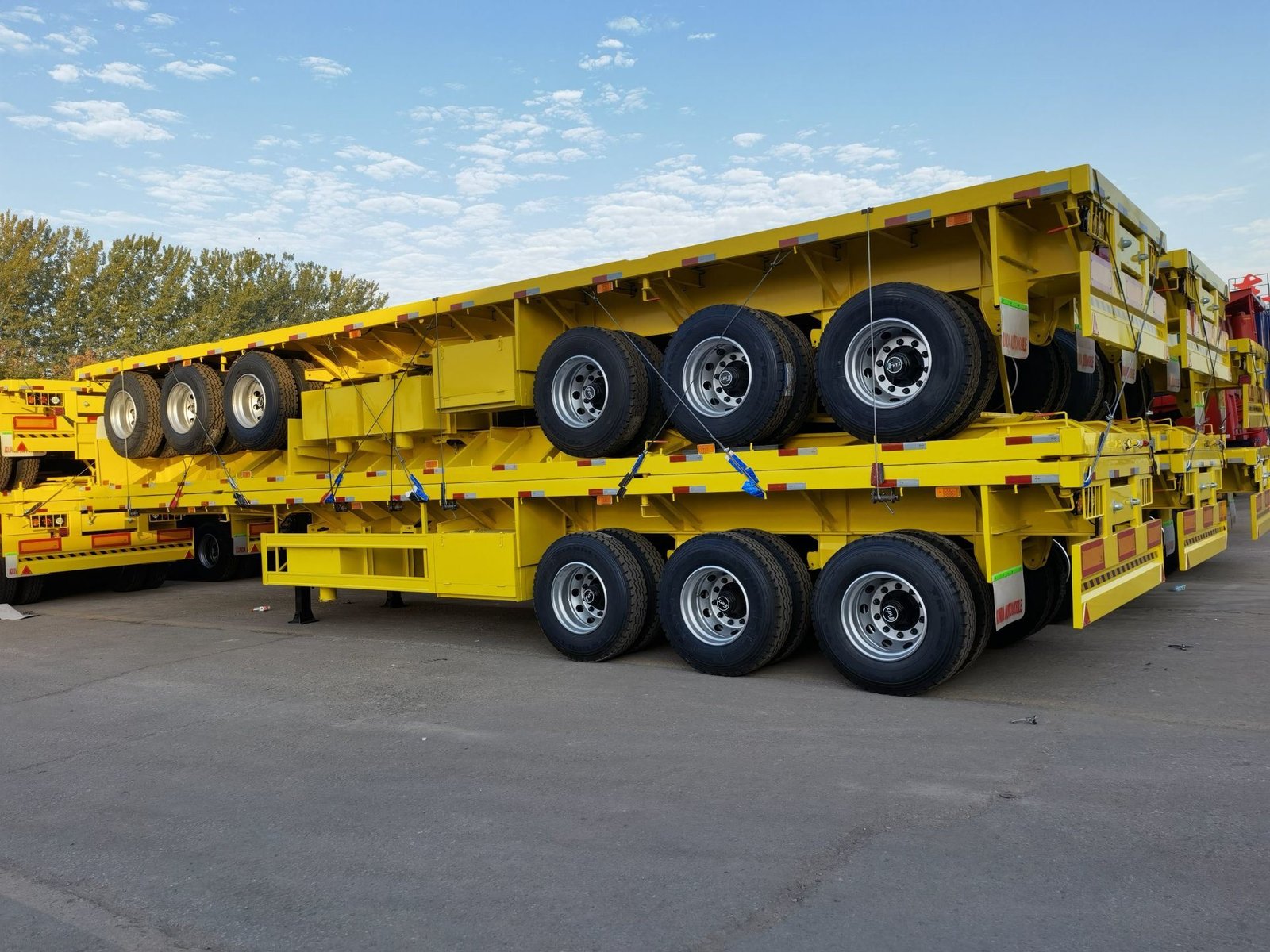
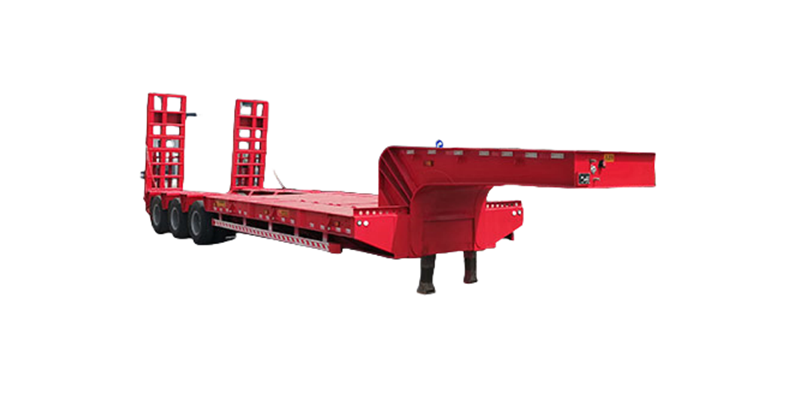
The ultra-low cargo platform is the core infrastructure for low flatbed semi trailers to achieve compliant transportation of ultra-high cargo and stable operation under heavy loads. Unlike the straight through high chassis design of ordinary trailers, it is not simply a chassis reduction or height reduction, but a systematic engineering design that integrates frame architecture innovation, chassis layout optimization, mechanical structure reinforcement, and spatial structure reconstruction. This design fundamentally solves the industry pain points of traditional trailers such as high cargo platforms, unstable center of gravity, oversized cargo, and difficult loading and unloading, and is a landmark core technology for heavy-duty transport trailers. This article will comprehensively analyze the core design principles of ultra-low cargo platforms from five dimensions: structural iteration logic, core architecture design, spatial layout principles, mechanical reinforcement design, and structural balance principles.
1、 Design iteration logic: Overthrowing the drawbacks of traditional trailer structures
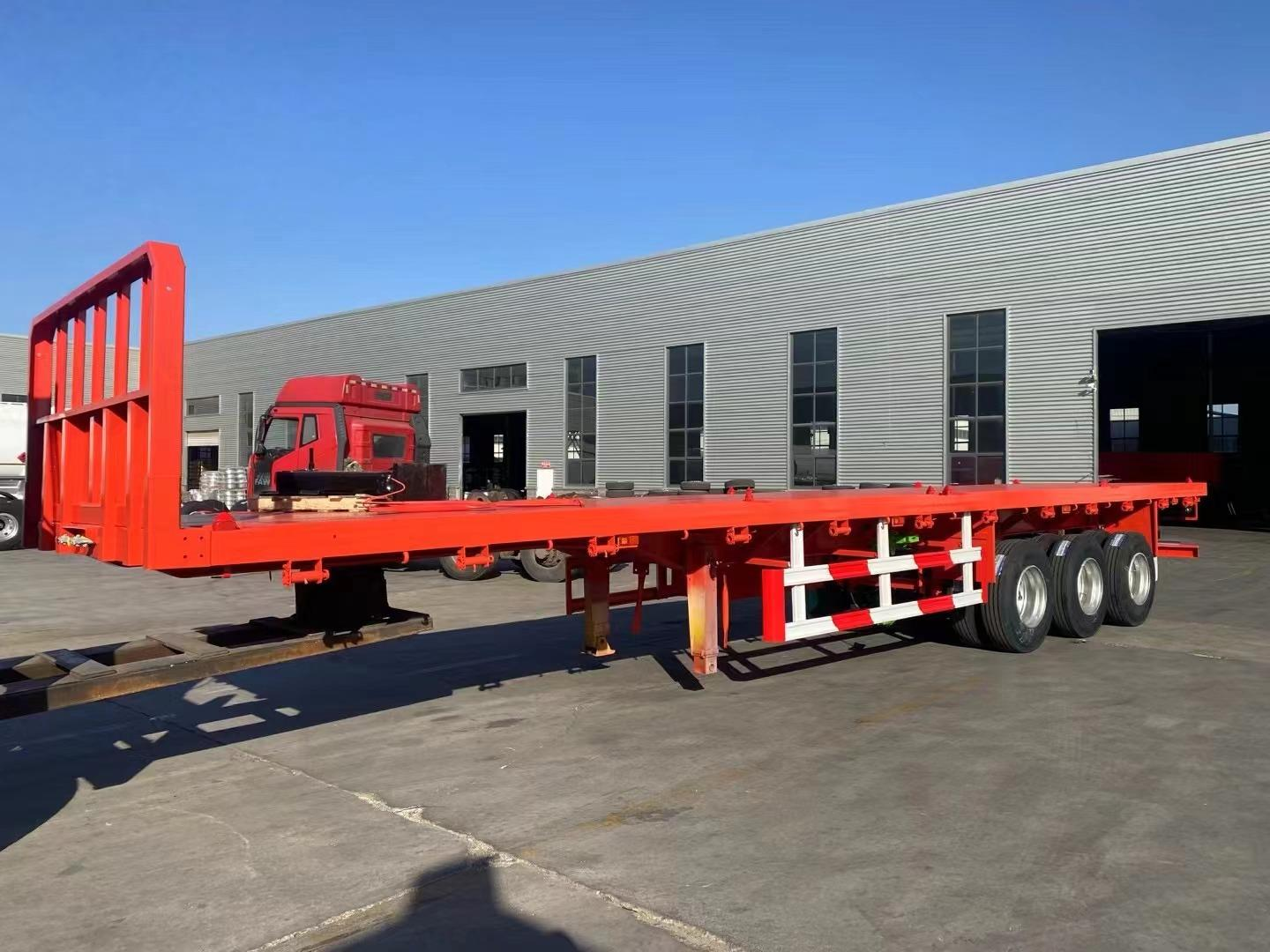
Ordinary freight semi trailers generally adopt a straight through longitudinal beam structure, with the frame longitudinal beam running through the front and rear of the vehicle. The entire frame is erected above the wheels and suspension, relying on raising the chassis height to ensure suspension bounce space and tire passage space. This structural design process is simple and has strong universality, but there are obvious shortcomings. The high cargo platform reference plane leads to a high center of gravity for the entire vehicle loading, and greatly compresses the effective height space for cargo loading. It cannot adapt to the transportation needs of ultra-high and overweight equipment such as construction machinery, large tanks, heavy steel structures, and large machine tools, and is prone to road height limit exceeding the limit.
The core iterative idea of the design of ultra-low cargo platforms is to reconstruct the spatial position relationship between the frame, wheels, and suspension without sacrificing load-bearing strength, driving safety, and structural stability. This eliminates the traditional high position chassis layout of trailers and achieves the design goal of “low cargo platform, high load capacity, and high stability” by minimizing the height of the cargo area through local sinking of the frame, outward displacement of the structure, and spatial reconstruction. It accurately meets the exclusive working conditions requirements of special heavy-duty transportation of large cargo.
2、 Core architecture principle: concave beam stepped sinking frame design
The concave beam stepped sinking frame is the core structure that enables ultra-low ground clearance for ultra-low cargo platforms, and it is also the most essential design difference from ordinary trailers. The vehicle frame of the ultra-low cargo platform adopts a three-stage stepped structure zoning design, which is divided into the front goose neck bearing area, the middle sinking cargo main area, and the rear straight connection area. Through differentiated longitudinal beam height design, a natural sinking cargo platform is formed.
Among them, the front goose neck area retains a reasonable height for connecting with the tractor saddle, ensuring the matching degree of the whole vehicle’s traction and turning flexibility, and meeting the dynamic driving needs of vehicle turning and U-turning; The core middle cargo area abandons the straight through and equally high longitudinal beam structure, and lowers and offsets the left and right main longitudinal beams as a whole, forming a concave low flat load-bearing platform, completely breaking away from the limitations of traditional longitudinal beam high-level layout; The transition in the rear area is smooth to ensure the flatness of the rear of the vehicle, suitable for ladder installation and equipment loading and unloading operations.
This three-stage stepped concave beam structure allows the entire vehicle to achieve ultra-low height only in the core cargo area, while retaining structural strength and assembly adaptability in key stress connection parts. It not only solves the problem of high cargo platform height, but also avoids defects such as poor traction matching and weak rear force caused by the sinking of the entire body, achieving precise zoning of structural functions.
3、 Space layout principle: external structure design with separated wheel frame
The core reason for the high height of traditional trailer cargo platforms is that the frame must cover above the tires and suspension, leaving buffer space for tire bouncing and road bumps. The width and height of the tires directly limit the minimum ground clearance of the cargo platform. The ultra-low cargo platform completely breaks through this space limitation through the disruptive principle of wheel frame separation and external tire layout.
In terms of overall layout design, the ultra-low platform trailer arranges the wheels, axles, and balance suspension of the entire walking mechanism on both sides of the main platform surface, no longer occupying the vertical space at the bottom of the platform. The cargo platform shrinks inward, sinks to the ground, and the walking mechanism is externally mounted, forming an exclusive spatial structure of “middle low platform cargo, two side wheel sets walking”. This layout completely avoids the constraint of tire size on the height of the cargo platform, without the need to reserve upper space for wheel group jumping, and can maximize the compression of the ground clearance of the cargo platform.
Based on this design principle, the ground clearance height of the standard compliant ultra-low cargo platform cargo area can be stably controlled between 0.6 meters and 1.1 meters. Compared with the cargo platform height of ordinary trailers ranging from 1.8 meters to 2.2 meters, the overall height reduction is nearly 50%, achieving the ultimate optimization of cargo platform height from the spatial structure level and providing a core foundation for compliant transportation of ultra-high cargo.
4、 Principle of Mechanical Reinforcement: Bi directional Compatibility Design for Low Height and High Load Capacity
The simple sinking of the chassis can lead to a decrease in the effective force height of the longitudinal beam, which can easily result in insufficient body stiffness, deformation under heavy loads, depression of the board surface, and distortion of the chassis. This is also the core technical weakness of early sunken trailers. The modern ultra-low cargo platform structure, through a complete set of mechanical reinforcement design, perfectly solves the contradiction between “low height and high strength”, achieving the unity of structural lightweighting and heavy-duty stability.
In terms of material selection, the main body of the ultra-low cargo platform frame is made of Q355 and Q690 high-strength alloy steel. Compared with ordinary carbon steel, the tensile strength, torsional resistance, and compressive resistance are greatly improved. While reducing the height of the beam and lowering the cargo platform, sufficient structural bearing capacity is retained. In terms of internal structural reinforcement, the sunken cargo area adopts dense through beams, horizontal and vertical cross reinforcement ribs, and closed box shaped beam structure, abandoning the sparse beam layout and allowing the entire cargo platform surface to form an overall load-bearing structure. The load can be evenly distributed to avoid deformation of the surface caused by local concentrated stress.
At the same time, in the stress concentration area where the goose neck is connected to the sinking zone, thick steel plates, triangular reinforcement, and overall welding technology are used to eliminate the hidden stress hazards of structural breakpoints, improve the overall anti torsion and anti bending ability of the vehicle, and ensure that the ultra-low cargo platform can stably carry heavy cargo of tens to hundreds of tons, fully adapting to the heavy-duty transportation conditions of heavy engineering machinery and large industrial equipment.
5、 Dynamic Balance Principle: Collaborative Design of Center of Gravity Downward Movement and Suspension Adaptation
The design of ultra-low cargo platforms not only involves static structural optimization, but also incorporates the principle of dynamic driving balance design. From the perspective of vehicle dynamics, the height of the center of gravity of the cargo directly determines the driving stability of the vehicle. The lower the center of gravity, the stronger the vehicle’s ability to resist rollover, offset, and shaking. The ultra-low cargo platform directly lowers the center of gravity position of all loaded goods by lowering the cargo reference plane, optimizing the overall weight structure of the vehicle from a physical perspective, and completely improving the dynamic drawbacks of traditional heavy-duty trailers with “high center of gravity and top heavy”.
At the same time, the ultra-low platform structure and multi axle balanced suspension system adopt a collaborative adaptive design, with external wheel sets matched with balanced suspension, which can automatically adjust the force and load on each axle according to road undulations, making the heavy load carried by the sunken low platform more evenly distributed, effectively buffering driving vibrations and bumps. The optimization of the center of gravity of the static structure and the force balance of the dynamic suspension complement each other, allowing ultra-low platform trailers to maintain a stable driving state under heavy loads, high speeds, bends, and complex bumpy road conditions.