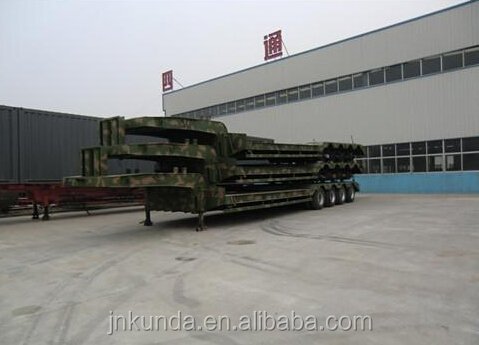
The ultra-low cargo platform is the core iconic structure that distinguishes low flatbed semi trailers from ordinary freight trailers, and it is also the key core for achieving safe, compliant, and efficient operations in the transportation of large heavy loads and ultra-high equipment. Relying on exclusive designs such as concave beam stepped frame, wheel frame separation external layout, and high-strength mechanical reinforcement, the ultra-low cargo platform completely solves the industry pain points of traditional trailers such as excessive height, unstable driving, difficult loading and unloading, and limited scenarios. Compared with conventional high platform transport vehicles, ultra-low platform has overwhelming advantages in multiple dimensions such as traffic compliance, driving safety, adaptability to working conditions, and operational economy. It is the optimal structural solution for the transportation of engineering machinery, large industrial equipment, heavy steel structures, and irregular large cargo. This article will systematically and completely dismantle the core application advantages of ultra-low cargo platforms.
1、 Breaking down height barriers and achieving compliant passage of ultra-high goods
In the road transportation system, the national highways, national roads, urban roads, tunnels, and bridges generally implement a 4.2-meter standard height limit, which is the biggest bottleneck for traditional large-scale transportation. The height of ordinary semi-trailer cargo platforms above the ground generally reaches 1.8-2.2 meters. When transporting equipment with a height of more than 3 meters such as excavators, rollers, large machine tools, and tank equipment, the total height of the vehicle is easily exceeded by the legal limit, causing the vehicle to exceed the limit and violate regulations. Not only can it not pass normally, but it will also face problems such as traffic restrictions, fines, and mandatory rectification. If it is necessary to pass, cumbersome over limit approval procedures must be handled in advance, which seriously affects transportation efficiency.
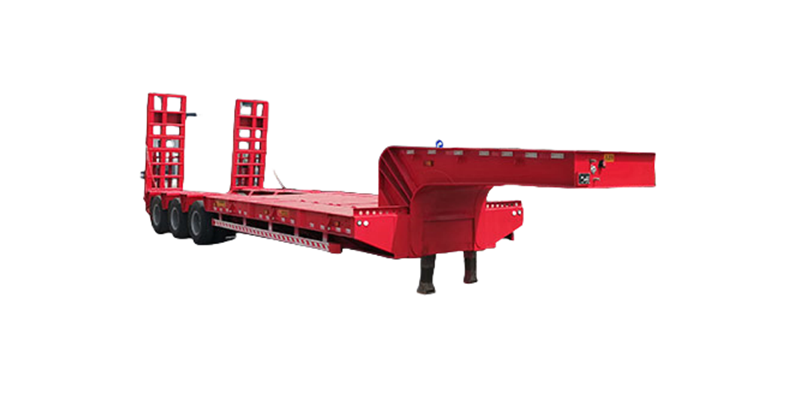
Through structural innovation, the ultra-low cargo platform controls the height of the core cargo area above the ground at 0.6-1.1 meters, significantly reducing the loading reference height. Under the same cargo conditions, the overall height of the vehicle can be minimized to the greatest extent possible. After the vast majority of ultra-high engineering equipment is loaded, the overall height of the vehicle can be controlled within a compliant range, without the need to dismantle equipment accessories, avoid detours, or repeatedly report for approval. It can directly pass through national main roads, urban elevated roads, and rural height restricted sections, greatly improving the capacity and efficiency of large-scale transportation and fundamentally solving the compliance problem of ultra-high cargo transportation.
2、 Significantly reduce the center of gravity of the entire vehicle and comprehensively improve the driving safety factor
The stability of heavy-duty driving of a vehicle depends on the height of the vehicle’s center of gravity. The higher the center of gravity, the greater the shaking amplitude of the vehicle when turning, changing lanes, braking, and crossing bumpy roads, and the higher the safety risks of rollover, cargo displacement, and body sway. After loading heavy equipment onto traditional high cargo platform trailers, the overall center of gravity is relatively high, and the entire vehicle presents a “top heavy, top light” state. When driving on long distances at high speeds, mountainous bends, and muddy bumpy roads, there are great safety hazards, which is the core reason for the high incidence of large-scale transportation accidents.
The ultra-low cargo platform sinks through the physical structure, directly lowering the cargo loading reference surface, causing the center of gravity of heavy-duty equipment and heavy cargo to move downwards as a whole, significantly reducing the center height of the entire vehicle and optimizing the vehicle’s counterweight structure from the root. A lower center of gravity can significantly enhance the vehicle’s anti roll, anti sway, and anti offset capabilities. In complex driving conditions such as high-speed straight driving, emergency braking, continuous bends, and uneven road surfaces, the vehicle’s posture is smoother, and the goods are less likely to tilt, shift, or loosen. This effectively avoids common safety issues such as rollover, cargo damage, and vehicle loss of control during heavy-duty transportation, and comprehensively improves the safety and stability of long-distance heavy-duty transportation.
3、 Lowering the threshold for loading and unloading operations, improving operational efficiency, and saving operating costs
The traditional high cargo platform trailer has a large ground drop, and the loading and unloading of heavy equipment and construction machinery must rely on professional lifting equipment such as large cranes and hoists for auxiliary operations. The operation process is cumbersome and time-consuming, and professional lifting personnel are required, resulting in high lifting and labor costs. Especially in outdoor construction sites, remote mining areas, rural infrastructure and other scenarios, it is difficult to allocate large lifting equipment, which easily leads to problems such as transportation vehicles being unable to load and unload after arrival, and delays in the construction period.
The extremely low ground drop of the ultra-low cargo platform greatly simplifies the loading and unloading process of large cargo. For construction machinery that can walk on its own, a dedicated detachable ladder can be used to enable the equipment to board and disembark independently, without the need for crane assistance. A single person can complete the loading and unloading coordination operation, greatly reducing the loading and unloading time and simplifying the operation process. At the same time, low cargo platforms are more convenient for operators to calibrate, bundle, reinforce, and inspect goods, avoiding the risks of high-altitude operations and improving operational safety. In long-term operation, it can significantly save lifting costs, labor costs, and equipment allocation costs, and significantly reduce the comprehensive operating costs of large-scale transportation.
4、 Highly adaptable, compatible with various shaped, large-sized, and heavy-duty goods
The ultra-low cargo platform adopts a modular design with an open flat tabletop, no railing, and no top cover, combined with an exclusive layout of external wheels. The cargo area is complete and flat, without protrusions or structural interference, and has strong cargo compatibility. Compared to the limitations of ordinary trailers that can only transport regular goods, ultra-low cargo platforms can fully adapt to the transportation needs of ultra long, ultra wide, ultra high, overweight, and irregular shaped goods.
Whether it is various construction machinery such as excavators, loaders, pavers, industrial equipment such as large tanks, pressure units, precision machine tools, or non-standard large goods such as ultra long steel structures, irregular molds, large building materials, wind power accessories, etc., they can be placed smoothly and reliably fixed. At the same time, relying on the load-bearing advantages of high-strength sinking frames, while maintaining ultra-low height, it can stably carry heavy loads ranging from tens to hundreds of tons, balancing the “low traffic advantage” and “heavy load carrying capacity”. It can adapt to all scenarios of heavy load transportation such as infrastructure engineering, mining operations, industrial logistics, municipal construction, and new energy equipment transfer, and its versatility and practicality far exceed ordinary transport trailers.
5、 Stronger road adaptability, reducing driving wear and tear on complex road conditions
On complex unpaved roads such as dirt roads, muddy roads, bumpy rural roads, and steep slopes in mountainous areas, traditional high chassis trailers have a high center of gravity and significant body shaking. During driving, they are prone to body bumps and cargo shaking, which not only causes damage to the goods but also exacerbates the wear and tear of the frame, suspension, and tires, shortening the service life of the vehicle.
The ultra-low cargo platform, with its low center of gravity and high stability structural advantages, works in conjunction with a balanced suspension system, resulting in better body fit during driving. The vibrations caused by road bumps are effectively buffered, and the overall vehicle posture is smoother. In complex road conditions, it can effectively reduce problems such as body distortion, cargo jumping, and tire uneven wear, reduce the driving wear and tear of the vehicle chassis, suspension, and braking system, reduce the probability of vehicle failure, extend the service life of the entire vehicle, and improve the vehicle passing rate and continuous operation ability under harsh working conditions.
6、 Improve operational economic efficiency and increase vehicle attendance rate
In actual transportation and operation scenarios, the advantage of ultra-low cargo platforms can be directly translated into economic benefits. On the one hand, it has strong compliance capacity and does not require frequent handling of over limit procedures or detours around restricted road sections, greatly shortening the transportation cycle and increasing the frequency of single vehicle transportation; On the other hand, there is no need to rely on cranes for loading and unloading, greatly reducing the supporting costs of single transportation, while also reducing the cost of compensation for cargo damage caused by unstable loading and unloading and driving.
In addition, the ultra-low cargo platform has a mature structure, stable mechanical properties, is not easily deformed under heavy loads, has a low failure rate, low maintenance costs in the later stage, short downtime for vehicle maintenance, and high attendance rate. Compared to ordinary trailers, ultra-low platform trailers are more adaptable to a wider range of goods sources, have more operating scenarios, and have lower operating costs. The comprehensive economic benefits of long-term operation are very prominent.